The Goals You Set in January Are in the Trash Before February. Why?
You Can Set As Many Goals As You Want... But Without Seeing This System I GUARANTEE Every Single One of Them Will Fail. Now I'm Going to Show You How to Sustain a Goal for 10 Years, 20 Years, and Even For The Rest of Your Life.
There's a Truth Nobody Has Ever Told You: Once You Learn This System, Not Just One Month — But Your Entire Life Can Change Completely

Now let me ask you a question...
Are you one of those people who constantly sets new goals in January, starts with huge motivation, but forgets those goals before February even arrives?
Forget about February…
You forget all of them before three days are even up.
Because There's a Truth Nobody Has Ever Told You...
Most people think that the act called "Setting Goals" is the right thing to do.
But in reality...
They aren't even aware that setting goals can ultimately turn them into unhappy, exhausted, and burned-out person..
And This Problem Is So Severe That…
It causes 92% of goals set worldwide to end up in the trash before February even arrives. And more importantly...
It shows you how every "successful person" you see on social media is sneakily sabotaging their own future.
And this same truth — if you don't leave this page for the next 10 minutes — could affect perhaps 10 to 20 years of your life. But most importantly...
After you learn this system...
Tomorrow you might suddenly decide to change your life.
You might want to make big changes in your career.
You might overhaul your family life completely. Because this is the kind of thing that…
Tomorrow you might find yourself getting out of bed to pursue a completely different purpose.
You'll finally know what you want in life. You'll have discovered yourself and your true identity.
Bold claim, right?
Yes, it is.
But behind this claim is a 6-year independent academic research project published on the OSF International Academic Platform. And more importantly...
Once You See This System...
You'll understand why all those personal development books you've read for years have done nothing…
Why those expensive coaching packages you bought lost their effect within weeks…
Why the Pomodoro technique, to-do lists, and "just do it" advice never carried you past a certain point. And the strangest part is...
Why for years you've been chasing not your own goals — but GOALS THAT BELONG TO OTHER PEOPLE…
You'll see all of these — one by one.
But right now, a voice in your head is probably saying:
"Who Is This Guy and What Is He Trying to Tell Me?"
You're right. You should keep your guard up.
Because the internet is full of people selling "miracle systems" that promise to change your life.
Most are scams. Most leave you worse off. Most are old ideas repackaged.
But I promise you...
What I'm about to show you in the next 10 minutes — is neither a scam, nor will it leave you worse off, nor is it "an old idea repackaged." Because…
What I'm About to Show You Is the Output of 6 Years of Independent Academic Research.
Hi, I'm Selman Uyanık.
I'm an independent researcher. I'm the founder of the Mental Restructuring Technique — where I combined habit management with the dopamine system for the first time in the world — the Story Meditations Genre, the Dopaminergic Perfectionism approach, and the DEPTH system.
And for the last 6 years, I've been wrestling with one critical question:
"Why Can't People Do What They Want?"
I pursued this question. I read. I researched. I published.
My studies are on open-access academic platforms — anyone can read, critique, or verify them:
… and I haven't even counted all my other studies in the pipeline…
But I'm not writing these lines to say "look how much I've produced and done."
I'm writing because what I'm about to tell you today — is something nobody has ever told you before.
And for a claim like this to stand, my work has to be traceable.
So I should also say:
The new model I'm about to show you has been tested with over 70 beta testers so far…
The copyright and educational rights belong entirely to me. (Meaning nobody else can teach this to you.)
It's a 5-step system.
And its name is:
Take a look at this...
Here's what people who saw this system wrote to me:
"First, thank you for making such a system accessible. 🙏
It was useful for me because I wasn't someone who knew what I wanted. I'd always make long to-do lists and not do them, I'd make vision boards but nothing would happen by year-end. I was splitting the year into quarters, and for 2 years every quarter's tasks were spilling into the next quarter — these were my problems.
And here's where I experienced the biggest benefit of your system: I got crystal clear on what would actually be good for me. I started to own who I am.
For example, deep down I knew that creative, freelance work would make me happy — but everyone around me was saying "study for civil service exams, that's what we did, it's secure," and my mind would drift toward that. I'd wonder if I was thinking wrong, if I was fooling myself — but no, I just wanted to be myself.
Now I've started to own who I am. 🤩
I might have had to read 10 different books to reach a system like this — seeing your system was enough 🙂 Thank you again, I wish you continued success. I'll keep applying your system. 🙏"
And then there's Aleyna, who works at a very prestigious airline (I can't give the company name for legal reasons). After learning this system, she wrote to me:
"Hello Selman… I've been a flight attendant for 10 years.
To reduce the downsides of my profession, eating healthy and exercising would help me keep doing this work for years longer. I knew that, but it felt hard — and it still does — but at least now I know why.
In this sense, we're in a completely different place than other people. The advice they give everyone doesn't apply to our lives.
Your priority was also adjusting the environment and conditions. I decided to stop being unfair to myself :)
The questions you asked in the work area / life architecture section made me think — maybe I should pivot toward different goals (becoming a ground instructor).
Truly, thank you."
Do you see?
These people started thinking — and even acting — to change the direction of their lives with this system. So, Miray quit the civil service exam track and pivoted to her true passion, and Aleyna, after just 2 hours of learning, decided she needs to leave the company she's worked at for 10 years. Can you believe it?
I get many more comments like these.
And here's the truth these comments reveal about this system:
This is genuinely SOMETHING TO BE TAKEN SERIOUSLY.
And I'm about to prove it to you…
But first, I need to confess something.
Before I started this research, I used to think like you.
"The problem can't be that people don't know how to set goals. Because anyone can set goals."
So I thought:
- "The problem must be motivation."
- "The problem must be discipline."
- "The problem must be time management."
"I Was Wrong!"
And millions of people fall into the same trap.
They look for the cause of the problem in the wrong places.
But the actual cause is in a place you've never even considered.
So now, let me show you…
Goals Aren't "Set" — Your Brain Manufactures Them By Inventing a Reason…
A short scientific truth.
Every moment you think you're setting a goal — your brain is actually playing a little trick on you.
Here's how the cycle works…
You see someone's success on social media.
You hear about someone's lifestyle on a podcast.
They explain their accomplishments to you, how they earned what they earned.
And they say to you…
"If You Follow This Path, You Can Reach This Goal Too."
You can earn this money, buy this house, and drive this car.
For example, one of these people…
Talks about how much money crypto made them,
Another…
Explains how e-commerce will change your life…
Yet another…
Talks about how becoming a digital nomad will lead you to financial freedom.
Or one of your own friends…
"There's so much money in this. Come on, let's get into this!" they say.
Sound familiar?
They tell you their own goals as if they were yours.
And each one — injects another "manufactured goal" into your brain.
Then in your brain — outside of your control — something happens:
A Big Dopamine Surge Is Released…
Within seconds.
Before you even realize it.
And after the dopamine is released — your brain immediately projects into the future:
It invents a goal to match that surge.
And you say to yourself:
If I want to be like that guy or girl too…
- "I should wake up at 5 AM too."
- "I should do what they're doing too."
- "I should pivot to their field too."
- "I should learn what they've learned too."
And you start taking action BELIEVING IT'S A GOAL YOU SET YOURSELF.
But you didn't set it.
Your brain just retroactively invented logic for the dopamine release.
And this isn't something I made up.
This is a cycle observed repeatedly in neuroscience research — externally arousing triggers like the perception of high gains and returns release dopamine in your brain and create a "wanting" impulse. Then you…
Slap a goal label on that impulse and feel like you chose it yourself.
So… your brain — without your awareness — decides on the goal the moment it receives the dopamine signal.
Then you mistake that decision for your own goal.
And you write it in your notebook.
Share it on social media.
Tell your friends about it.
See it as a point to reach in the future.
And on January 1st, you decide: "I'm definitely going to do this."
But the moment you try to take one step forward…
Either you can't move forward, or if you somehow reach the goal — you can't be happy in the life that goal brings.
Think About It…
There's someone who values freedom and wants flexible work hours. That's actually who they are.
One day, they come across an Instagram video of a restaurant owner. And the video says:
'I opened my first restaurant with very low cost, and made $30,000 profit in the first month. Now I'm going to show you how I did it. I'm revealing my exclusive secrets…'
This person watches the manager's video, and their brain instantly releases a big dopamine surge.
Then the brain immediately manufactures a goal: 'If it's that easy and that cheap, I can do it too. I'll open a restaurant too.' And they get to work.
Months pass. The restaurant opens. They work 7 days a week, from 6 AM to 10 PM.
Money comes in.
But one morning, as they get out of bed, they realize:
This Life Isn't Theirs.
They realize they never actually loved this work.
Waking up at 5 AM isn't for them. Leaving work at 10 PM isn't for them either.
And now they drag themselves to work. Can't get up in the morning, can't sleep at night. Stress never ends. Arguments start in the family. They can't focus, motivation is gone, they can't enjoy life.
There's money — but that money came at the cost of their freedom.
Now let me ask you:
Do you think this goal was right for someone whose true identity is built on freedom and flexibility?
Obviously not.
Because that goal — wasn't born from their real identity, vision, or current situation.
That goal was just a dopamine residue.
That's why in your own life you might have noticed this strange truth:
Even Your Goals From 10 Years Ago Keep Changing Based on New Dopamine Sources!
At 18, you probably wanted very different things.
At 25, different things.
At 30, completely different things.
You might have interpreted this as "I've matured."
But the truth is:
The dopamine sources you were exposed to changed.
And your goals changed along with them.
So the most important truth for you now is this…
You've Never Actually Set "Your Own Goal" In Your Entire Life.
Your brain constantly sets new goals based on the content you saw and the advice you got.
And you — you chased those creations, lost, blamed yourself, gave up, wrote a new one…
Years passed.
And when you looked back — a strange feeling formed:
"I Don't Know What I Actually Want."
Because you never decided what you wanted in the first place.
Your brain made a new decision every day based on what you saw on social media or the advice you got from those around you.
I know this is a frustrating truth.
But this truth — is the first step to getting you out of this cycle.
Let's continue…
The SMART Goal Model Was Written in 1981 by a Management Consultant — Not For You.
You've probably heard this acronym:
- Specific
- Measurable
- Achievable
- Relevant
- Time-bound
That is… SMART.
Every personal development book teaches this.
The coaching industry is built on it.
Companies use it.
But here's what you don't know:
This framework wasn't written for human psychology.
This framework was written in 1981 by George T. Doran, a management consultant, in the "Management Review" journal — to help middle managers in corporations write project goals.
That is, not to help humans set goals…
But to set goals for products.
To set goals for marketing campaigns.
To establish production targets.
But at some point, the personal development industry saw this and said…
"We can adapt this framework for individuals too!"
And from that moment on, millions of people — for 40 years — have been trying to apply a corporate-process framework to their own lives.
The result?
92% of goals end up in the trash before February even arrives…
Because SMART Doesn't Ask You These Questions:
"Is this goal aligned with who you are?"
"Does this goal arise from your vision, or someone else's vision?"
"Which identity will carry this goal?"
Goals set without asking these three critical questions fail 92% of the time.
Because a goal — is not a project.
A goal — is an external expression of an identity.
And a goal set without clarifying your identity is like a fire burning in a house without a chimney:
It produces heat, but the smoke chokes you.
This is the result of trying to do the right job with the wrong tool.
The SMART framework teaches you to set goals.
But goals can't be set…
Goals can only and only…
Yes, exactly that.
Setting and deriving are not the same thing. Setting means choosing — picking one from a list. Deriving means distilling — extracting from your own essence.
And now the critical question is:
If goals can't be set and can only be derived…
From where should they be derived?
In what order?
What elements, combined in what sequence, will produce a goal that's "truly yours"?
Now, to understand this, picture a distillation tower:
In a chemistry lab…
A complex liquid goes in at the top, and a purified extract comes out at the bottom:

A distillation from your own essence, your own being.
That's how your goal works too.
If it passes through the right tower — a purified extract that belongs to you comes out.
If it doesn't pass through the right tower — what comes out is a confused liquid mixed together from fragments of the last person you saw on Instagram.
And when these five factors work simultaneously, in the right order, with the right questions — the goal emerges by itself.
Then you're not "setting" a goal.
You're distilling the goal.
And so, goal derivation also has 5 factors.
And the name of the system where these 5 factors converge is:
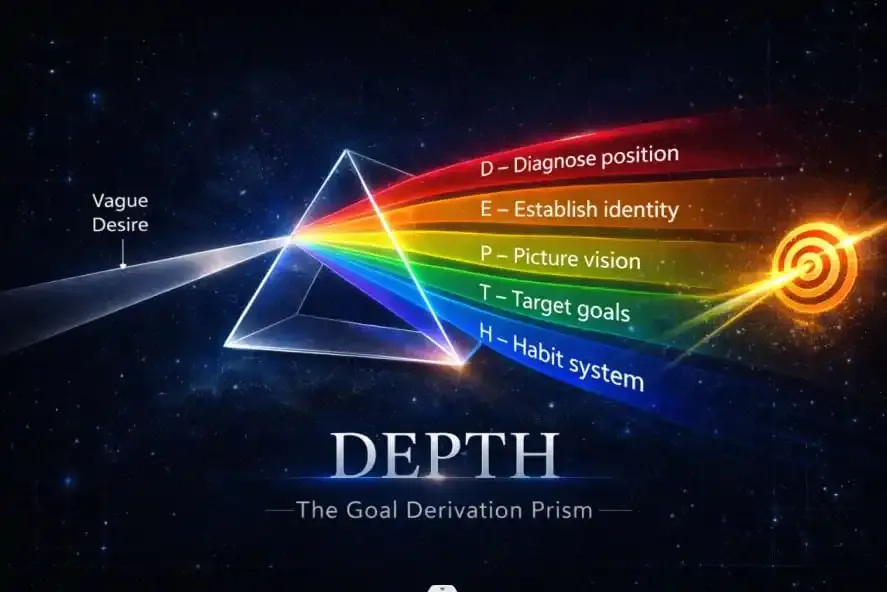
DEPTH is a five-step distillation process.
Each letter represents a step.
Just understand the logic:
Diagnose — Diagnose Your Current State
Where are you stuck right now? What kinds of problems are you experiencing?
Establish Identity — Establish Your Identity
Who are you, and who do you want to become?
Picture Vision — Picture Your Vision
What kind of life do you want to build?
Target — Derive Your Goal
What concrete goal emerges from this diagnosis, identity, and vision?
Habit System — Build Your Habit System
With what daily routine will you carry this goal forward?
Look carefully — the goal (T) comes at step four.
Before the fourth stage, you must have completed three other steps.
The traditional approach puts the goal first.
What's more — forget about the order, the others aren't even in the picture!
But DEPTH places the goal at the second-to-last step.
And it makes the other steps mandatory.
These 4 different shifts — change everything.
Now I'll show you what happens at each step.
What you actually do. What actually changes.
We begin with D.
D — Diagnose
Before setting a goal, you stop and ask yourself:
"What's actually holding me back?"
Motivation? Time? Energy? Attention? Environmental? Structural?
Most people set goals without ever asking this question.
In DEPTH, this question — is where everything begins.
There are 4 areas: Energy and physical infrastructure. Attention and time. Repeating patterns. Environmental obstacles.
In each area — you identify the real leak that's holding you back.
And you realize: "My problem isn't motivation. My problem is this."
For the first time, the correct diagnosis is made.
E — Identity
Now it's not "what do I want," it's "who am I".
What's your work style? What are your core values? What can't you tolerate? What are your repeating patterns?
The answers to these questions form an identity statement.
And that identity statement — becomes a filter that screens every goal you'll set from now on.
If a goal doesn't match this identity — that goal isn't yours.
Now you can see this in advance.
P — Vision
Not the fantasy — the architecture.
At this step, you don't ask "Where do I want to be?"
You ask: "What kind of life will I live when I reach that goal?"
You make that life concrete across 7 areas.
- Work structure.
- Income structure.
- Daily rhythm.
- Location.
- Social structure.
- Free time.
- The prices you're willing to pay.
Because many goals — fail because their cost is never seen.
In the vision step, you see that cost up front. You either say "I really want this" or "no, this isn't mine."
Both are wins.
T — Target
Now you can set a goal.
But this goal doesn't come from thin air.
It comes from your diagnosis. From your identity. From your vision.
It passes through 3 filters: Does it match my diagnosis? Is it aligned with my identity? Does it serve my vision?
A goal that passes all 3 filters — is then clarified using the SMART format.
What I'll do. How I'll measure it. Is it realistic. Does it match my identity. By when.
When you finish, you have — perhaps for the first time — a goal that truly belongs to you.
But the goal isn't the end.
You also need the engine that will carry you there:
H — System
Even the right goal — without a system to carry it — hangs in the air.
At this step, you build a 3-layered habit system.
Daily repetitions: trigger → action → completion marker.
Environmental design: make the right behavior easy, make the wrong behavior hard.
Minimum standards: don't break the system even on bad days.
And every week, every month, every 3 months — review.
The system is a living thing.
Because you are a living person too.
And All of This — In One Book.
At each step — there's a chapter explaining the topic, followed by fields to fill in.
When you finish, you have a concrete goal derived from your own diagnosis, identity, and vision, plus a habit system aimed at that goal.
- Your diagnostic map.
- Your identity statement.
- Your vision paragraph.
- Your derived goal.
- Your habit system.
These aren't abstract concepts.
These are what you wrote on your paper.
And the name of this book is:
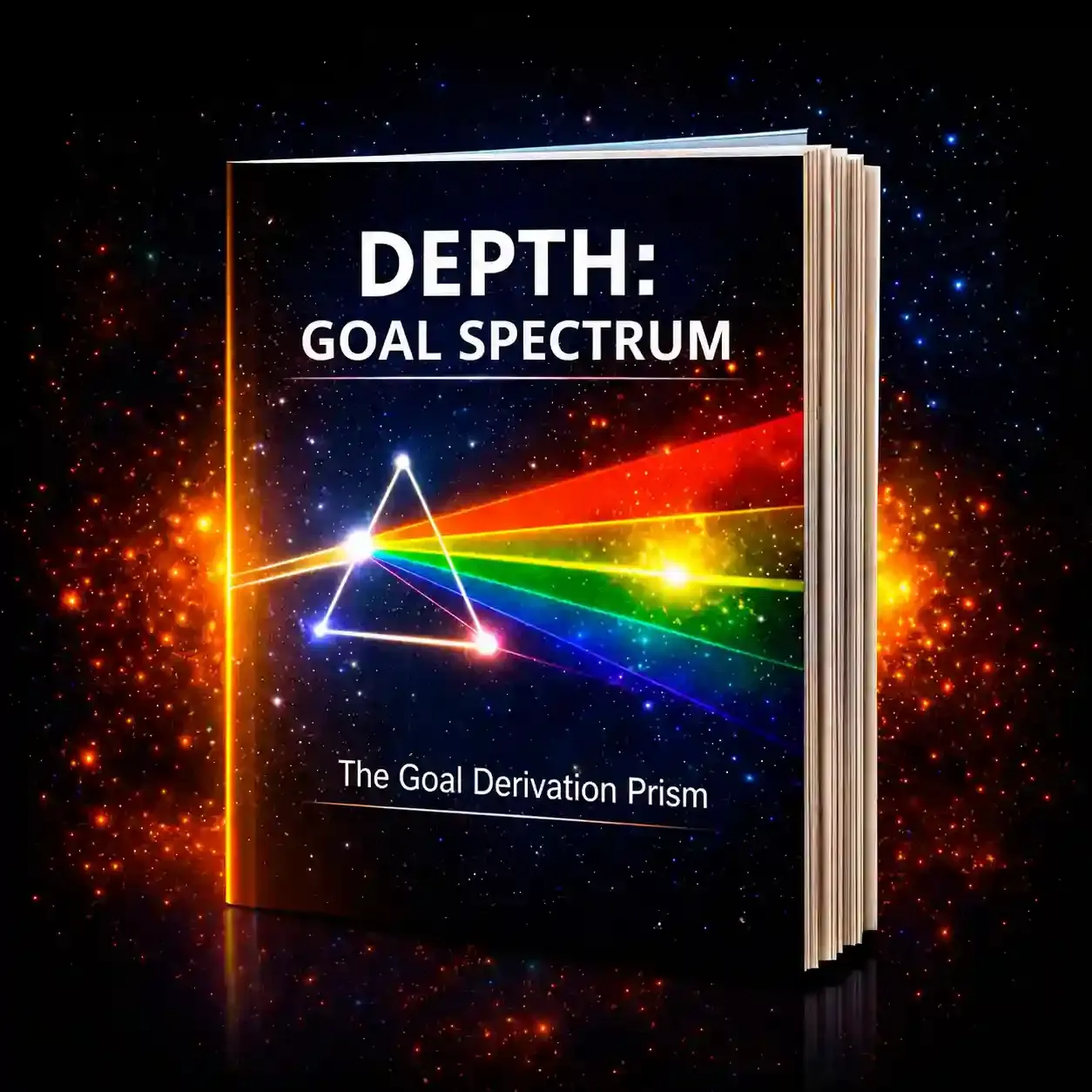
This book — is not a motivation book.
This book — is not a personal development book either.
This book is a workbook built on a 5-step distillation process.
After every chapter you read, there are fill-in fields where you write your own answers.
So you're not just reading. You're producing.
When you finish, you'll have — for the first time — a goal that truly belongs to you, of a kind you've never set before.
And the identity, vision, and daily system to carry it — right at your fingertips.
If you've read this far — this system most likely speaks to you.
You'll see the details, bonuses, and price below. But if you're in a hurry, you can start now.
What Readers of This Book Say
Hello Selman, I had the chance to read the book. Apologies for the delayed feedback.
I especially loved the part where you don't put the goal first but instead choose goals that fit after defining ourselves. Your emphasis on how imitated visions and goals aren't sustainable was very apt.
I also find your efforts to make clear definitions in problem analysis very valuable. I read it as a kind of root-cause investigation; because superficial statements like "I don't have motivation" can often mislead us.
Unfortunately, today most goal definitions remain "imported." Your emphasis on developing consistent and applicable habits for the goals we set is very critical for getting results.
Finally, I should add: this is in no way a cliché personal development book; it's like a handbook for the process of building a system. Great work, this is a very valuable study.
"Hello Selman, I had the chance to read the book. Overall, I'd say I found it useful.
Especially the fact that, instead of jumping straight to the goal, you first clarify the current state and what the person actually wants — I think that's the right approach.
What stood out most to me was the section about how people generally misdefine the problems they're experiencing. It explains well that what looks like a lack of motivation could have other underlying causes.
From that angle, it forces you to stop and think a little. The flow was comfortable while reading, the language doesn't tire you out.
Overall, it provides a useful framework, especially for people trying to clarify what to focus on. Thank you for your work."
"Hello Selman, I can say it was truly very useful.
I'm not someone who has had a lot of trouble setting and achieving goals, but your book gave me a perspective that can make the process so much easier.
It made me think that the process of reaching a goal doesn't have to be this draining, after reading it. Thanks to the examples you gave while reading, it was easy for me to adapt them to myself.
Overall I found the book productive. After all those goals we set with excitement and the inadequacy we feel when we can't achieve them — I think that once we put the steps you wrote into practice, we can free ourselves from that feeling.
I can express my overall evaluation this way. Thank you for your work."
"Hello Selman, it would be more accurate to say I had the chance to start your book. I haven't finished it yet due to work and some other things going on.
However, with the Diagnose section, you brought clarity to my uncertainty.
With Establish Identity, you clearly showed the difference between the personality I want to be and who I am. You held up a mirror to the uncertainty I'd been living with.
As I said, I haven't finished yet, but I aim to in the shortest time possible. For that reason, I sincerely thank you for being instrumental in my journey of self-discovery, for putting in writing how to balance my goal and personality and what to prioritize, and for sharing this with us.
I really liked your writing. Great work. I wish you ease on your journey as well. Best regards."
"Hello Selman. This is Oya.
The book was certainly useful. There's no such thing as a useless book 😊.
While reading, I kept feeling like I was late. The application section of the book is thought-provoking and really requires time.
You put in real effort, thank you. I should also note that it's worth coming back to it from time to time. Great work."
But wait.
Along with the book — there are 7 more bonuses.

Identity Statement Library
You may struggle while writing your identity statement in DEPTH's E step. This library contains 50 different identity statement templates. Each one for a different life area: career, relationships, health, creativity, leadership, service. It speeds up DEPTH's E step by 3-4x.
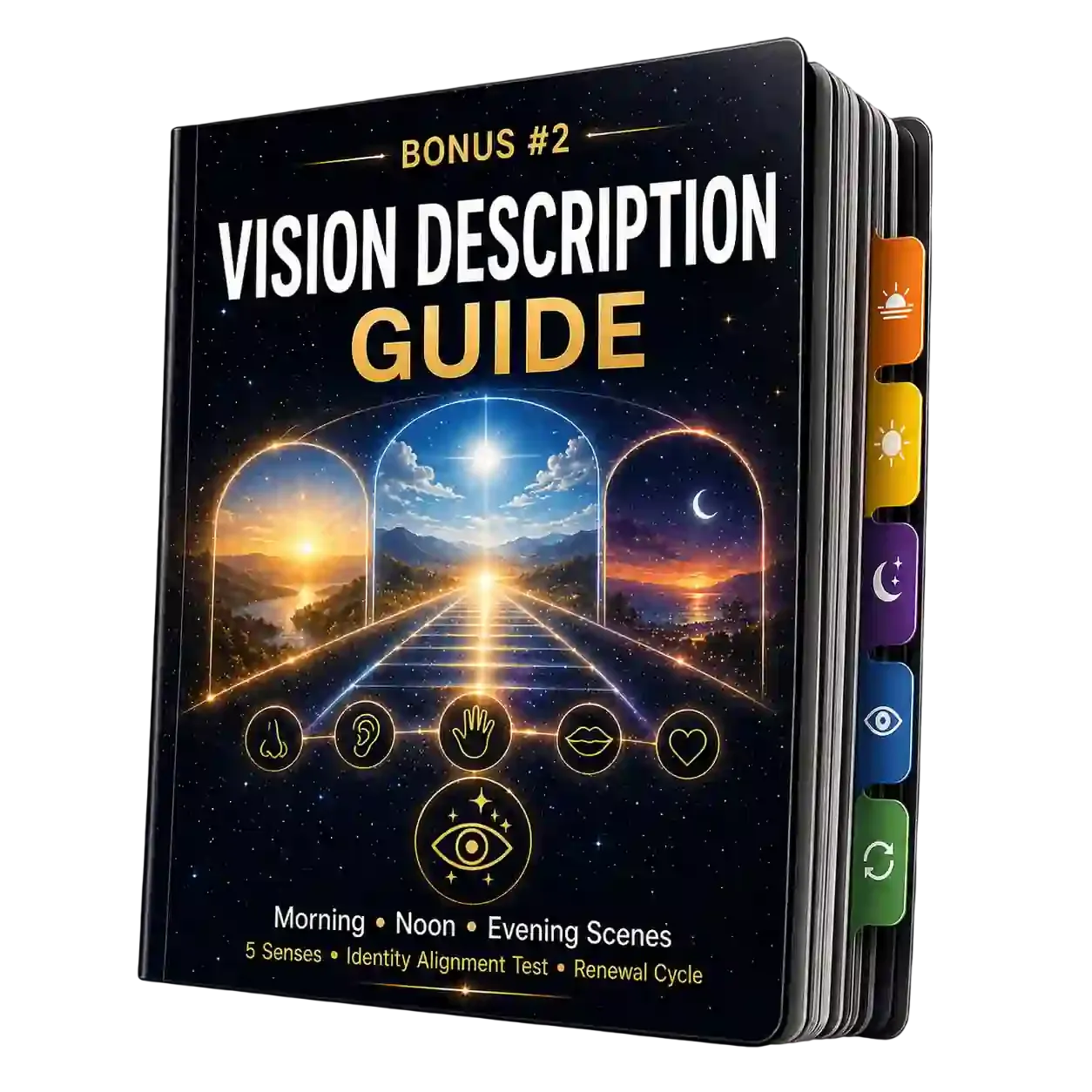
Vision Picturing Guide
In DEPTH's P step, you need to design 10 years into the future with sensory detail. This guide gives you step-by-step visualization techniques. Morning / Noon / Evening scene construction. Sensory detail checklist (5 senses). Identity alignment test. It makes DEPTH's P step 10x deeper.
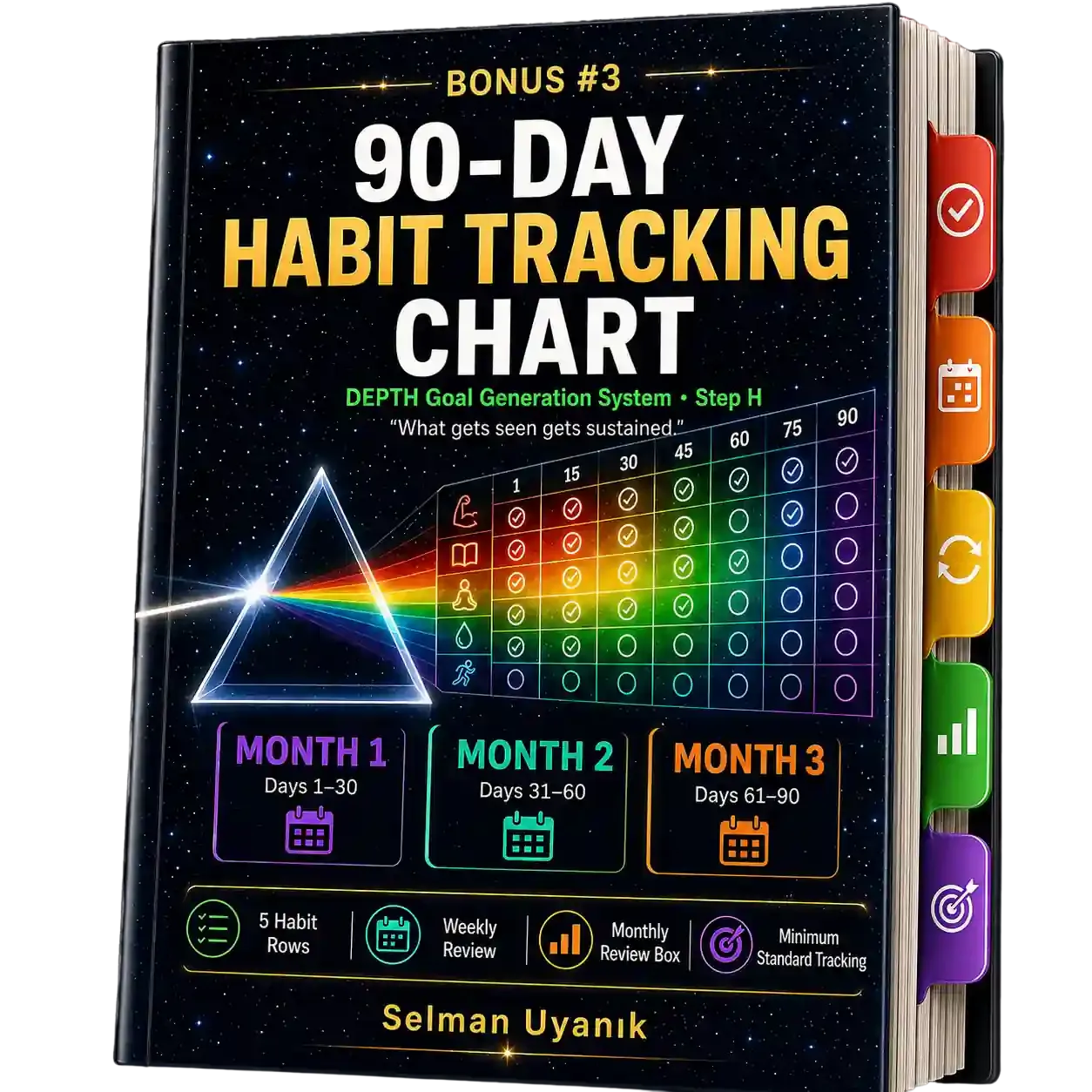
90-Day Habit Tracking Sheet
The moment you build the system in DEPTH's H step — you need to track it. Because an untracked system fades. Printable PDF: 90-day grid table. Daily 5 core action rows. Weekly review. Monthly evaluation. You can hang it on your wall. What is visible — is sustained.
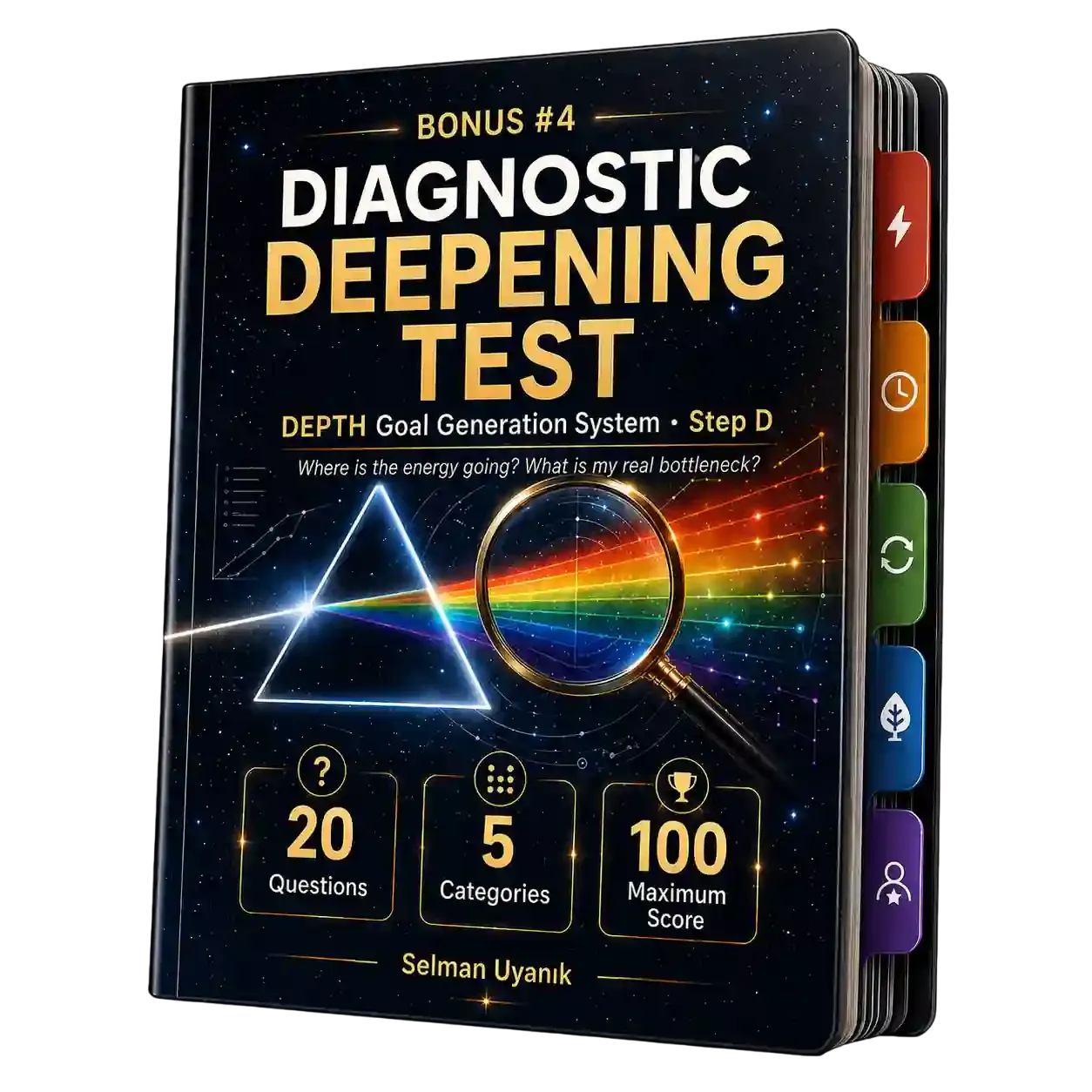
Diagnosis Deepening Test
DEPTH's D step asks you: "What's actually holding you back?" But most people pass over this question superficially. This test reveals your real bottleneck concretely through 5 categories and 20 questions. When the test is done, you have a concrete diagnostic map in your hands.
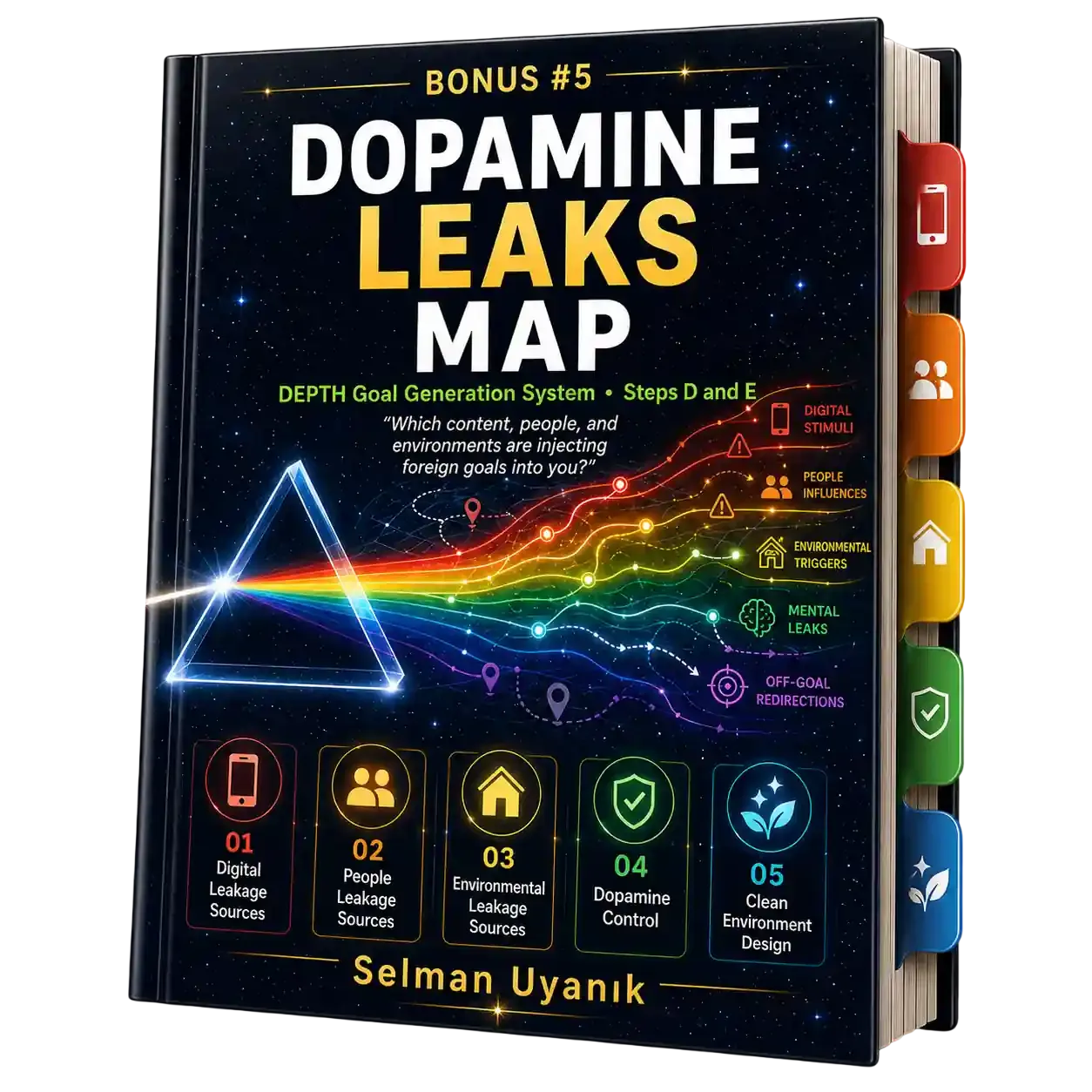
Dopamine Leaks Map
Your brain manufactures goals based on external stimuli. So who's giving you those stimuli? Which Instagram account? Which podcast? Which friend? Which industry environment? In 3 categories — digital sources, people, and environments — you see every source that injects foreign goals into you, one by one.
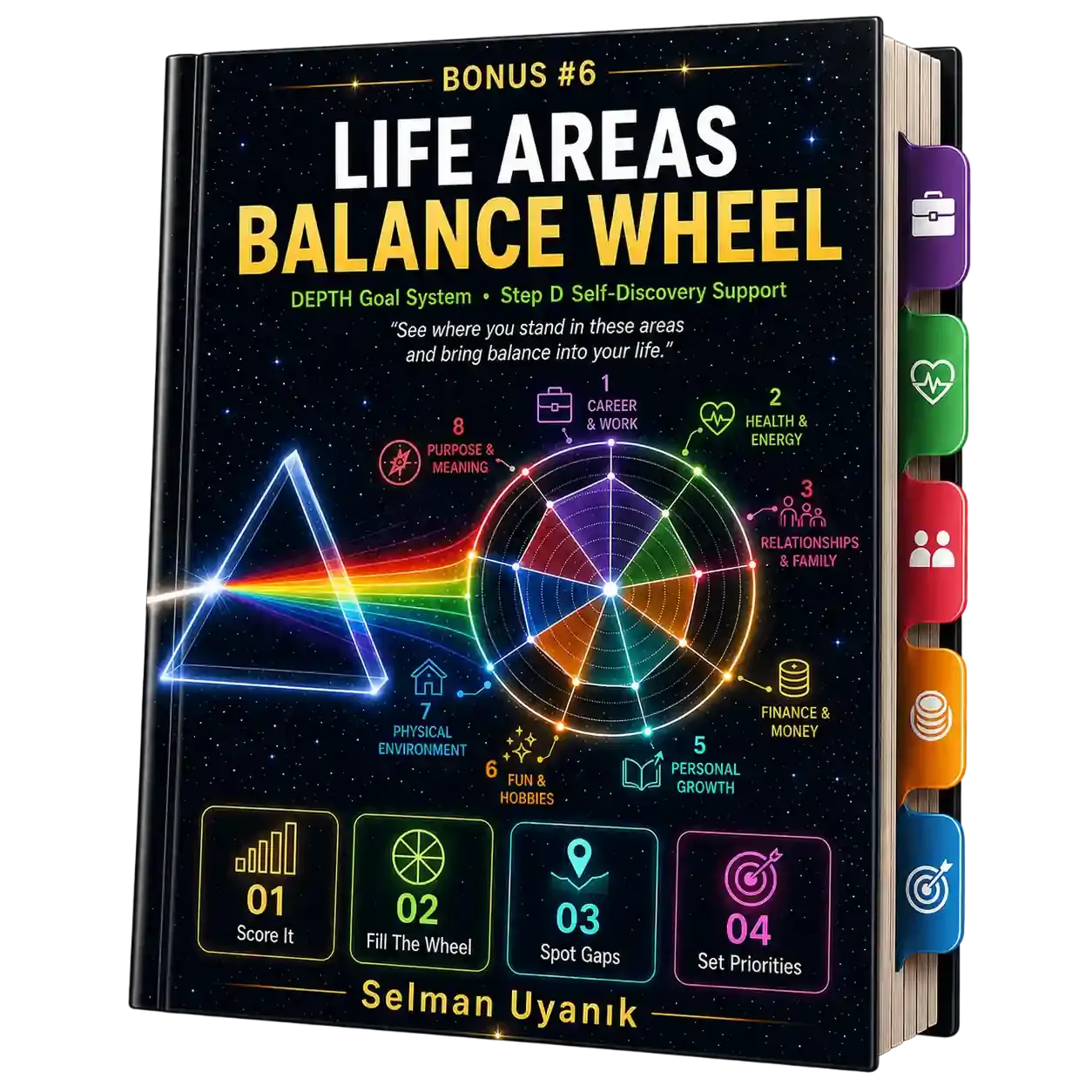
Life Areas Balance Wheel
The feeling of "I have no motivation" — is usually not a motivation problem. It's a blockage in a specific area reflecting onto the entire system. This wheel visually maps out 8 fundamental areas: Career, health, relationships, finance, personal growth, leisure, physical environment, and meaning.
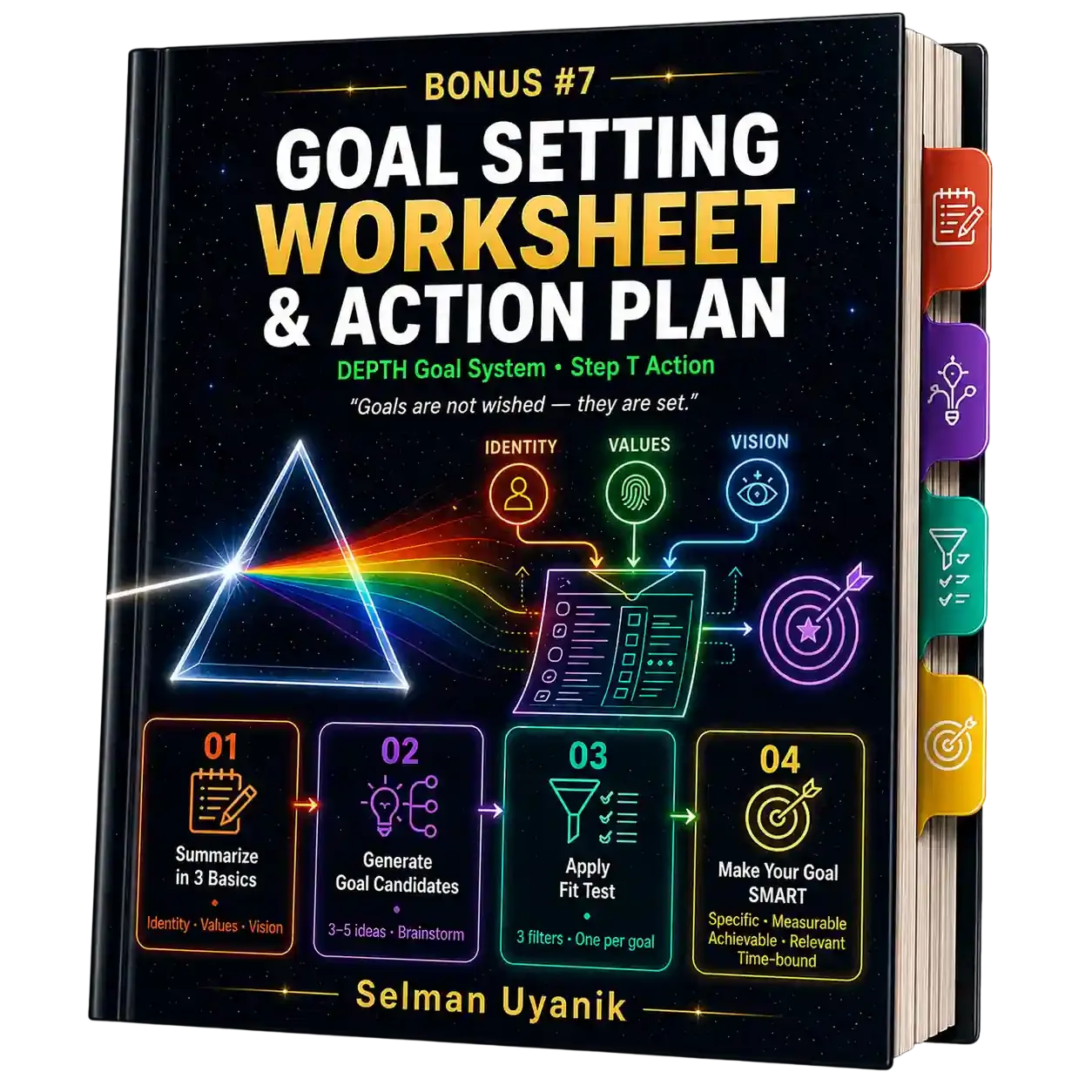
Goal Derivation Worksheet
You've completed DEPTH's four steps. Now all that remains is to put the goal on paper. Four steps: Combine the diagnosis + identity + vision summary. Generate 3-5 goal candidates. Pass each candidate through 3 filters. When you're done you'll have a goal you didn't set — you derived.
Total Value of the Package
So What Are You Paying?
Think about it for a moment.
To solve this problem — how much money have you spent so far?
Bought personal development books?
$15-30 × 10 books = $150-300.
Joined a motivation or time-management course?
Average $200-500.
Worked with a life coach?
Current session fees are $100-300. 6 sessions = $600-1,800.
Tried therapy?
As of 2026, therapy session fees in major U.S. cities range from $150 to $300.
4 sessions per month = $600-1,200.
Annual total = over $7,200.
Someone who has tried just these four alternatives once — has easily spent $1,000-3,000.
And none of them — can solve the goal-derivation problem at its root.
Because none of them can even name this problem.
You don't have to spend $1,000-3,000 to find out why your goals aren't sticking.
I'm not even selling you this package for $176.
Not even for $97.
Today — on this page — right now, just:
Buy the main book — 7 bonuses completely free.
A package worth $176 — for just $47.
Why This Price?
Because we're currently in a launch period.
DEPTH's academic paper was just published on the OSF International Platform.
In the coming months, we're in talks with domestic and foreign publishing houses.
The moment it moves to professional publishing — the price can rise significantly.
Marketing and distribution costs may come into play.
Also — I'm limiting this launch period to the first 500 people.
Once I reach 500 people — the price may return to its normal level.
What's more… in the coming months I'll be turning this book into a video-based course.
So the real value of this price is: more than $176.
But for now, only for 500 people, it's $47.
It's not mandatory, but…
This audience will be the first group to give me references, comments, and feedback.
When the system grows with their feedback — the price will grow too.
But I'm going even further for you, and I'm so confident in my system that…
I'm Giving You a 60-Day Money-Back Guarantee!
If you get the book and all the bonuses, apply all 5 steps, complete all the fill-ins, and feel it provided no benefit to you —
With a single email — your full payment is refunded within 60 days. No questions asked.
I take on all the risk.
Because I know the system works.
I applied it myself. 70+ early readers applied it. Its academic framework is open-access on OSF. My other program in this field is registered with the Ministry of Culture.
The only thing you have to do — is try.
If it doesn't work — you lose nothing.
But if it works — it saves you 10 years, 20 years, and a lifetime.
Now You Have Two Options
✕ Option 1: Close this page.
Tomorrow, tell yourself "today will be different" again.
Live the same disappointment in the evening, again.
Next January, write the same goals all over again.
And maybe spend another 10 years — going in circles in the same loop.
I don't judge this option.
Sometimes people aren't ready to change.
✓ Option 2: Get DEPTH.
Apply the 5 steps within this week.
When you finish — perhaps for the first time — you'll have a goal that's truly yours.
And the identity, vision, and system to carry that goal.
I'm laying both options out clearly.
Because this is your life.
Your decision.
I'm a guide. But you're the one walking the path.
I'll say this:
A year from now — will the goals you're chasing actually be yours?
Or will they once again be copies derived from someone else's vision?
Today's decision — will determine that.
A life chasing someone else's goal… is exhausting.
A life chasing your own goal… is full of energy.
The difference starts right now, with you.
If you close this page and leave — you'll check Instagram 3 more times.
Each time — 3 new "manufactured goals" will be injected into your brain.
Before this year ends — you'll set at least 20 more different goals.
And in January 2027 — you'll probably remember this page, this sentence, this moment.
"I wish I had bought it then..." you'll say.
But if you get it today — in January 2027 you can be a completely different you.
Chasing a goal that's entirely yours.
Not from someone else's vision — but a goal derived from your own identity.
With this money — you're buying back your last 10 years.